2025/12/31
These final four flicks are the cream of the crop -- the best movies that I've had the pleasure to see this year. In th--
=]=:< <"Nice place! Let's get liquored up and shit!!"
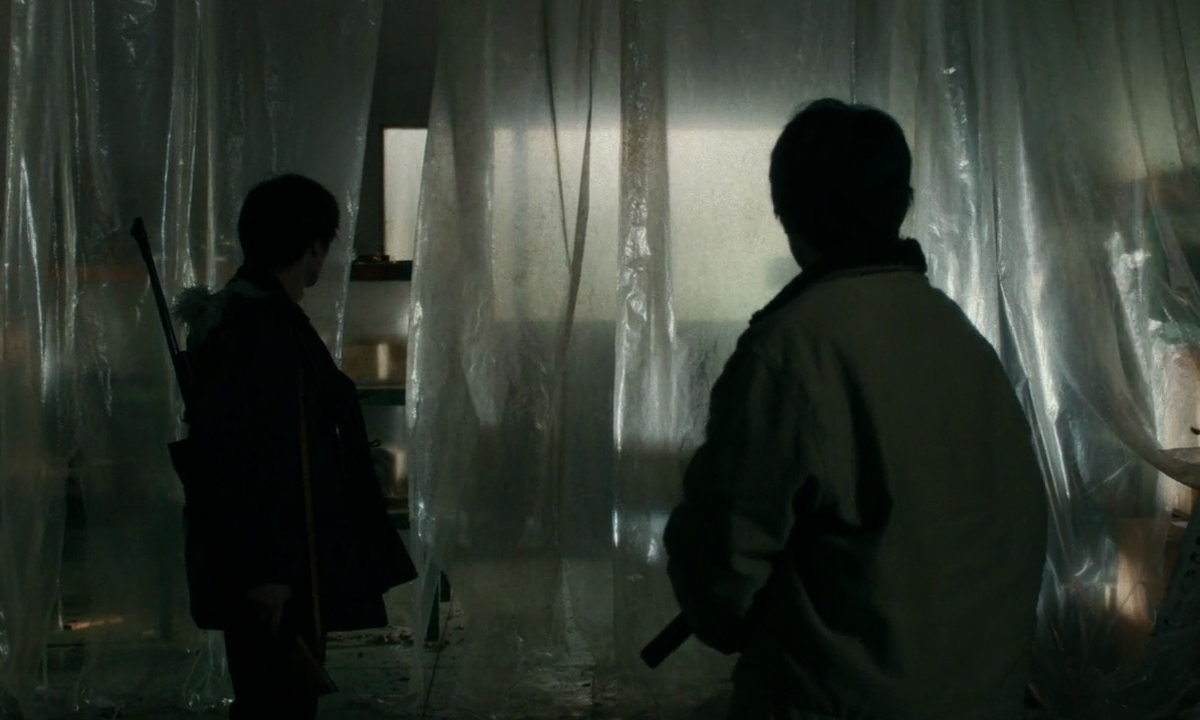
Preemption, predatory purchases, and sales of inauthentic designer goods are among the many means by which a factory's diligent employee and unscrupulous private reseller (Masaki Suda) profits exploitatively while unwittingly accumulating online enemies. He declines an offer by a former schoolmate (Masataka Kubota) to invest in a new auction site, then relocates with his acquisitive girlfriend (Kotone Furukawa) from Tokyo to a lakeside estate, where he hires a reliable adjutant (Daiken Okudaira) and suffers local harassment before he's confronted during a chaotic afternoon by armed assailants, whose begrudging threats quickly escalate into violence. Along with Chime and his remake of Serpent's Kiss, Kiyoshi Kurosawa occupied his sixty-ninth year with this gradually suspenseful, socially satiric, superbly shot actioner whose characters and themes are naturally established during its first hour before its second bursts into jolting, riveting chases, gunplay, and surprises from the aging auteur, who diverts with tricks newly adapted from Peckinpah's, and a few of his hallmarks by which he signals to his longtime fans. Primarily a genre exercise, it's also an effective critique of ennui, unchecked umbrage, empty materialism, oniomania, and simple greed that unsentimentally drives its point home during a surreal conclusion. At the end of his seventh decade, Kurosawa still had plenty to show and tell in trappings of simple entertainment.
=]=:< <"This is definitely one for you: he's a reseller, his chick looks like a cute bug, and shitty people get killed, but it left me cold. No quadrupeds, and we never got to see him rolling in glory for selling all those little figurines."
Well, maybe someday we'll get a Blu-ray containing all those deleted scenes.
=]=:< <"Don't you patronize me."
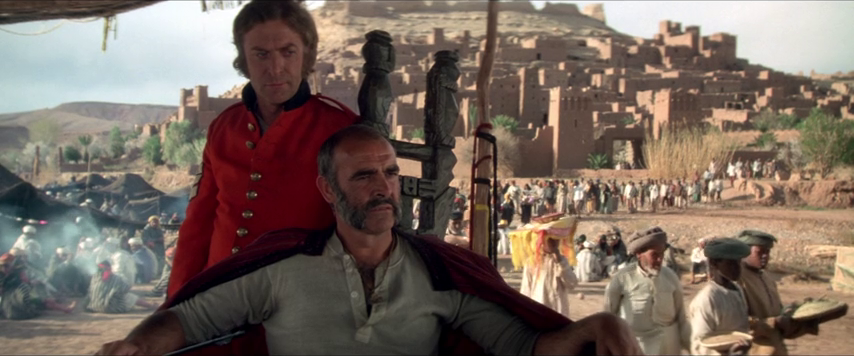
Former NCOs of the British Army (Michael Caine, Sean Connery) subsist comfortably on chicanery in British India, but these ambitious swindlers have a loftier goal: to trek to Kafiristan with a cache of rifles, raise an army, conquer localities, and plunder their wealth. All goes well with the translational aid of a faithful Gurkha soldier (Saeed Jaffrey) until Connery's warrior-tricheur is apotheosized by locals -- an exploited development that eases their conquest and leads them to what's left of a syncretic Alexandrian settlement and its astonishing fortune....before redounding to their downfall. John Huston meditated to cinematize Rudyard Kipling's colonial novella for decades, and his eventual realization of this pet project is the best of his late pictures -- an adventure as rich in boldly dramatic masculinity as action, tinged with wry facetia effortlessly quipped by Caine and Connery, who stand larger than life upon their director's tragicomic epic. Christopher Plummer is almost unrecognizable and a fine foil to the deceptive duo as Kipling himself, the journalist who witnesses their partnership, warns them against the perils that they're determined to surmount, sees them off....and receives what returns, and pitiably remains thereafter.
=]=:< <"I have so many questions about this movie, but I'll just ask one: what does Connery do when he has to take a dump? Everybody knows that deities don't defecate."
That's rough, when every excretion has to be furtive.
=]=:< <"Yeah, but how?! They got no toilet paper in Kafiristan, and since everybody's watching him, he doesn't have enough time or opportunity to dig a hole, much less squat over it."
I'll tell you what: I'll read the novella and report back on whether Kipling addressed this.
=]=:< <"Okey-doke. Oh, and speaking of shit:"
	INT. JAZZ BAR - LATER

	CUE: The live music plays in ultra slow-motion.

	LONG LENS ON -
	The two of them are now accompanied by some attractive
	looking strangers. A woman kisses at LÁSZLÓ's neck but he
	tries to focus on the music.

	WE PAN DOWN to see GORDON blatantly fingering his new
	girlfriend who sits on a bar stool.

				BAR MANAGER (O.S.)
				(shouting)
		HEY! HEY! GET THE HELL OUT OF HERE!

	LÁSZLÓ and GORDON are slow to respond.

				BAR MANAGER (CONT'D)
				(shouting)
		Get the hell out or I'll beat the
		shit out of you two.

	LÁSZLÓ comically vomits on himself where he stands.

				BAR MANAGER (CONT'D)
		OH, HOLY HELL. I'm gonna kill that
		son of a bitch!

	EXT. JAZZ BAR - MOMENTS LATER

	The BAR MANAGER and a bouncer beat the hell out of LÁSZLÓ who
	laughs madly. STEAM RISES from the sewer grates.

	ANGLE ON -
	The crack of LÁSZLÓ's nose re-breaking.

				LÁSZLÓ
		My nose! Damn it.
=]=:< <"Mind you, these two low-lives are the protagonist and deuteragonist, who just did a bunch of heroin in the previous scene."
Lovely. The punch line is worth it, but only if you're reading this.

Late at night, two small children (Lucas Paul, Dali Rose Tetreault) are terrorized by a poltergeist and observe uncomprehendingly as their home's windows and doors vanish before their morose parents (Ross Paul, Jaime Hill) follow. Minacious magic resides in writer/director/editor Kyle Edward Ball's plain, grainy, abstruse, nightmarish first feature, which shows little and tells less in static shots and pans of homey interiors and inexplicable happenings therein. Not everyone's imaginations will be spurred by Ball's slow mode of creeping horror, but for those attuned to his cyclic ingeminations, evanescences, eerily domestic and surreal scenery, and quiet tensions jarringly disrupted by noises commonplace and otherwise, they've the uncanny rings of reality and dreams alike. It's a rare, true success of genuinely experimental cinema that agitates the viscera and hindbrain as few others have. The hype is true!
=]=:< <"This one's cool, but I fell asleep waiting for something to happen. I sleep like dead meat, so none of those noises made a difference."
So do I, but I didn't fall asleep.
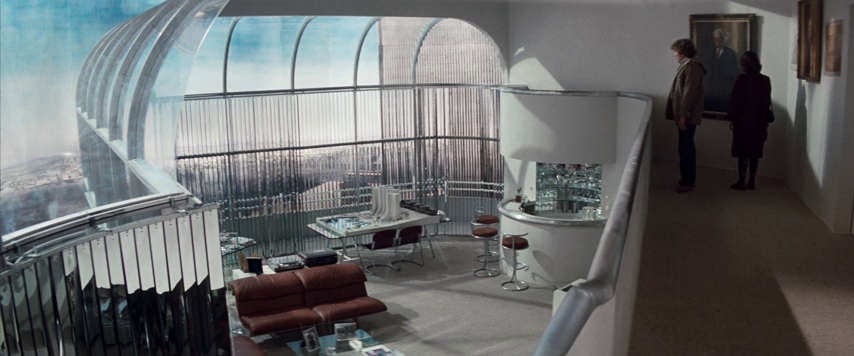
As a prelude to redevelopment, demolitions occur weekly in a slum of the South Bronx, where an undocumented subspecies of Canis lupus has the presence of mind to eschew the diseased organs of junkies and other derelicts who they devour. After they track and gorily dispatch the razing realty developer's famously wealthy proprietor (Max M. Brown), his glamorous wife (Anne Marie Pohtamo), and hulking Haitian bodyguard (John McCurry) in Battery Park, a weathered detective (Albert Finney) who's assigned to investigate their murders collaborates with a criminologist (Diane Venora), coroner (Gregory Hines), and zoologist (Tom Noonan) to probe the possibility of a pack's predation. The slain tycoon's security firm investigates sects of leftist terorrists who abominated him, but that jaded inspector's instincts sift suspicion toward militant Native American ironworkers (Edward James Olmos, Dehl Berti, Joaquin Rainbow, John Ferraro, Rino Thunder, et al.) who labor and socialize on Manhattan Bridge. Seasoned cinematographer and Woodstock director Michael Wadleigh helmed Orion's glossy adaptation of Whitley Strieber's popular novel with great panache and niceties as roundabout as its plot, and it's remarkable for its eccentric cast, Gerry Fisher's gritty, colorfully magnificent photography, and a few immersive sets, such as the murdered magnate's chic, plushy penthouse and a burnt-out church that was actually constructed, torched, and strewn with disposed pews and trash along Seabury Place for maximal verisimility. Wolfish perspective shots were realized with a low-slung Steadicam mount (operated by its towering inventor Garret Brown), and pseudo-thermographic in-camera effects. Leitmotifs and other passages of James Horner's archly, brassily bombastic, Goldsmithesque score were later reworked by the composer in his music for The Wrath of Khan, The Search for Spock, and Aliens. One of three coincident, lupine horrors of '81, its budget of $17M far exceeded those of An American Werewolf in London ($5.8M) or The Howling ($1.7M), and it flopped with box office receipts of $10.6M that were exceeded by those of its competitors at $62M and $20M, respectively. Notwithstanding Wadleigh's failure to efficiently conduct a production that was poorly scheduled and needlessly overexpensive, his results are nonetheless impressive as both a suspenseful thriller and a sympathetic, comparative allegory that emphasizes without syrup or sanctimony how threatened tribes of man and wolf struggle to adapt to postmodernity, and how that era's much-lauded technology is in some ways only clumsily replicating biological precedents.
=]=:< <"How do the wolves stay clean? Do the Indians bathe them?"
Maybe they just lick each other clean.
=]=:< <"Eww. Well, I wouldn't be caught dead slumming. It's the swamp for me."
© 2025 Robert Buchanan